Keeping and Breeding of Giant Leaf-Tail Gecko (Uroplatus giganteus Glaw, Kosuch, Henkel, Sound & Böhme, 2006) at BION Terrarium Center

BION Terrarium Center has many years of experience in keeping Giant leaf-tailed gecko (Uroplatus giganteus Glaw, Kosuch, Henkel, Sound & Böhme, 2006).
Giant leaf-tailed gecko (Uroplatus giganteus Glaw, Kosuch, Henkel, Sound & Böhme, 2006) is a member of a so-called “U. fimbriatus group” of leaf-tailed geckos.
That includes also:
- Uroplatus fimbriatus (Linnaeus, 1758);
- Uroplatus henkeli Böhme & Ibish, 1990;
- Uroplatus sameiti Bohme & Ibish, 1990;
- Uroplatus sikorae Boettger, 1913.
For more info pls visit: http://uroplatus.info/archives/70.
U. giganteus is the biggest species of the genus. Its SVL is 210–230 mm (8.27-9.06 in), TL is up to 110–120 mm (4.33-4.72 in) (total length 310–325 mm (12.21-12.79 in). Total length of young geckos is 90–110 mm (3.54-4.33 in). U. giganteus at first glance resembles typical U. fimbriatus. But the color of iris is plain cream to white at daytime and develops a fine red stripe pattern after nightfall (http://uroplatus.info/archives/70) while U. fimbriatus demonstrates yellow color of the iris.
Also morphology of hemipenises is a feature that helped scientists to find out that U. giganteus and U. fimbriatus are two different species (Glaw et al., 2006; Gehring et al., 2018).
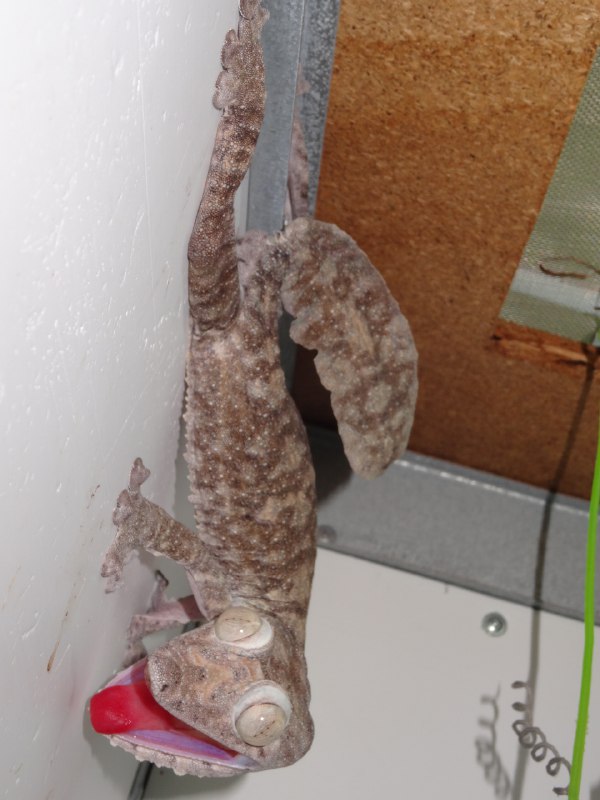
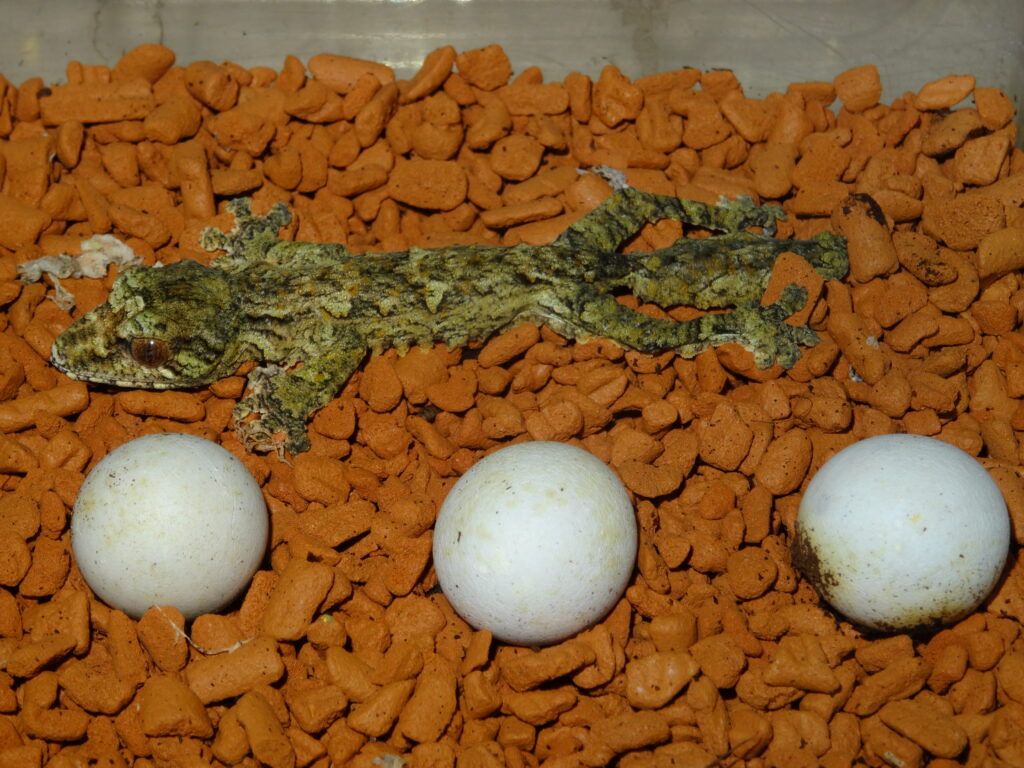
Keeping. We keep these big lizards separately or in pairs (1.1) in 90*65*120 cm vertical terrariums. During the first 1.5–2 months of life we keep babies in 30*30*30 сm terrariums or plastic containers, that have good ventilation, with further moving to bigger boxes.
The decoration of the terrarium consists of large vertical and horizontal branches for adult individuals and medium vertical and horizontal branches for juveniles, as well as lianas, living or artificial plants. We use big pieces of oak bark covering the bottom of the enclosure as a substrate for adults.
We keep juveniles for the first 6 months with a paper towel instead of bark substrate. Decoration includes thinner branches and smaller pieces of bark. Water dish is obligatory.
Lighting. We use Zoo Med 5 UVB or full spectrum lamps for lighting: at mating season for 12-14 hours a day; during other part of the year and prior to wintering it is 9–10 hours a day.
Temperature. We keep U. giganteus withdaytime temperature of +24 – +26 °C, and nighttime temperature – +19 – +21 °C. We do not provide a basking spot.
Humidity. For both juveniles and adults we maintain air humidity of 75–90% with double spraying during the day.