Keeping and Breeding of Veiled Chameleon (Chamaeleo calyptratus Dumeril & Dumeril, 1851) at BION Terrarium Center
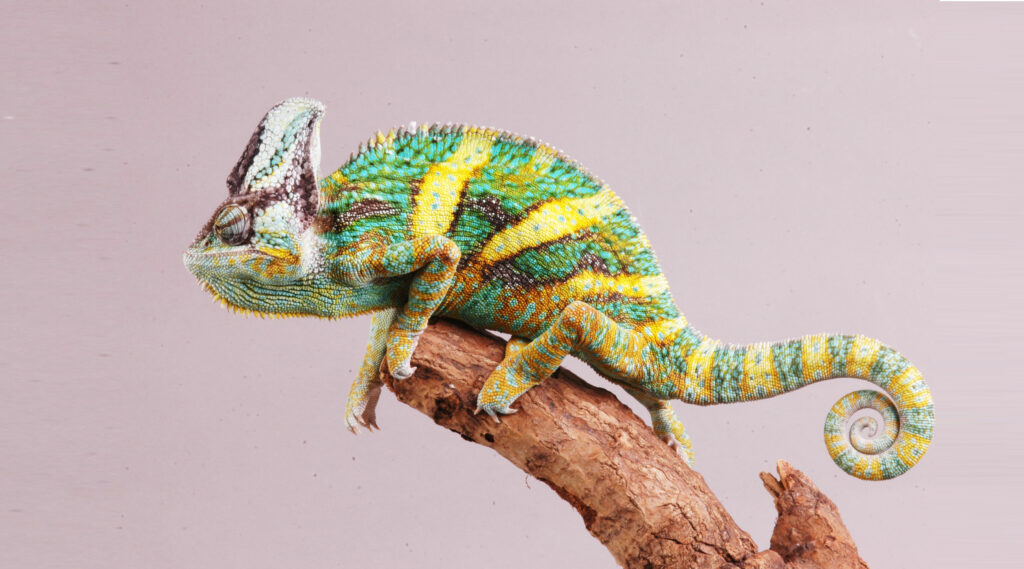
BION Terrarium Center has many years of experience in keeping veiled chameleon (Chamaeleo calyptratus Dumeril & Dumeril, 1851).
Veiled chameleons (Chamaeleo calyptratus Dumeril & Dumeril, 1851) also known as Yemen chameleons or cone-head chameleons inhabiting border lands between Yemen and Saudi Arabia. They occupy mainly inland river valleys as well as high, dry plateaus to an elevation of almost 3,000 feet.
These arboreal reptiles prefer to live high up in trees or lower near the ground in bushes and shrubs. They can live in dry areas and are found on plateaus of mountainous regions, forests and valleys (https://animaldiversity.org/accounts/Chamaeleo_calyptratus/).
The temperature range that they tolerate is from +24 °C (75 F) to +35 °C (95 F). Adult veiled chameleons are quite big, reaching total length of 45 cm (17–7 in) for males and 30 cm (11.8 in) for females. Their coloration usually includes bold circling bands primarily of bright gold, green and blue mixed with yellow, orange or black. Background coloration is green and in rare cases (bad health, gravidity)—grey. They also have very long cones on their gular crest.
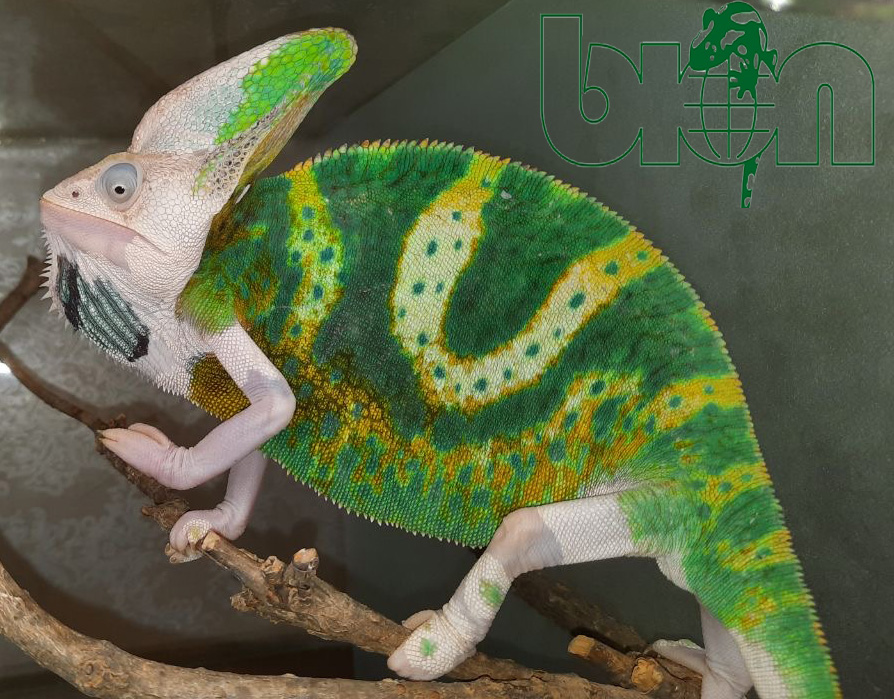
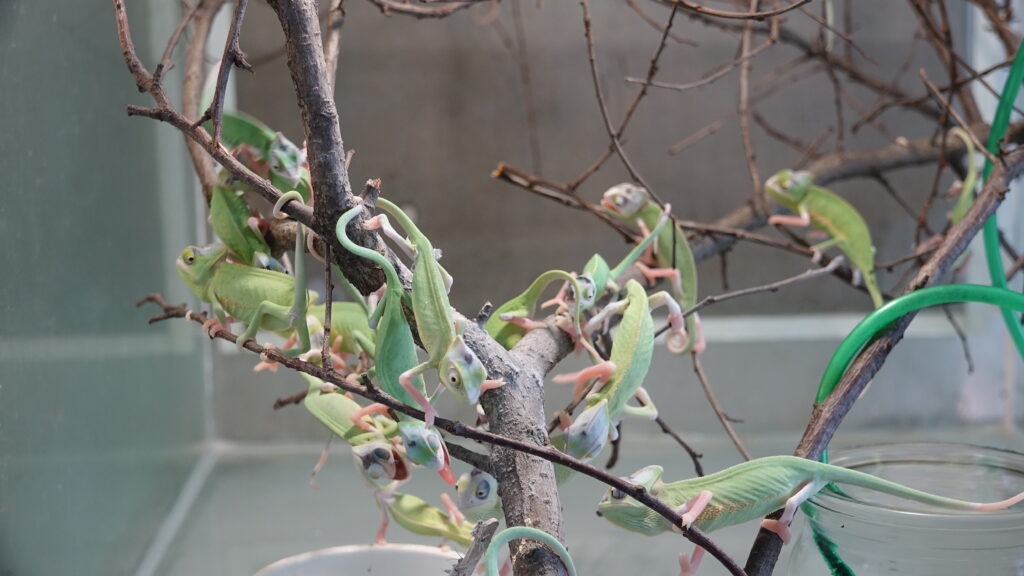
Keeping. We keep adult veiled chameleons in pairs or separately in 90*45*90 cm (35.43*7.08*35.43 in) vertical glass or plastic terrariums.
However the bigger space can be provided for a chameleon the better it would feel. The walls of the terrarium can be made of plastic, mesh or hybrid (combination of mesh and glass or plastic panel). We use no substrate for easier cleaning of the enclosure and control of excrements. It is also safer for the chameleons as they will not intake substrate when foraging for occasional free moving insects inside the enclosure.
Interior decoration includes branches of appropriate thickness, water bowl; living plants in pots are preferable. We didn’t witness any harm from artificial plants, but according to most of the world’s chameleon keepers they are not a good decision. So we use them in very rare cases. One can make an automatic water dripping system to let the water drops fall down the leaves and branches imitating natural moving of water. This is useful since not all the chameleons get used to drink from water bowls.
Our labs are also equipped with small fans in order to provide good air moving and therefore prevent the animals from respiratory diseases (Diaz et al., 2015).