Keeping and Breeding of Mossy Leaf-Tailed Gecko (Uroplatus sikorae Boettger, 1913) at BION Terrarium Center
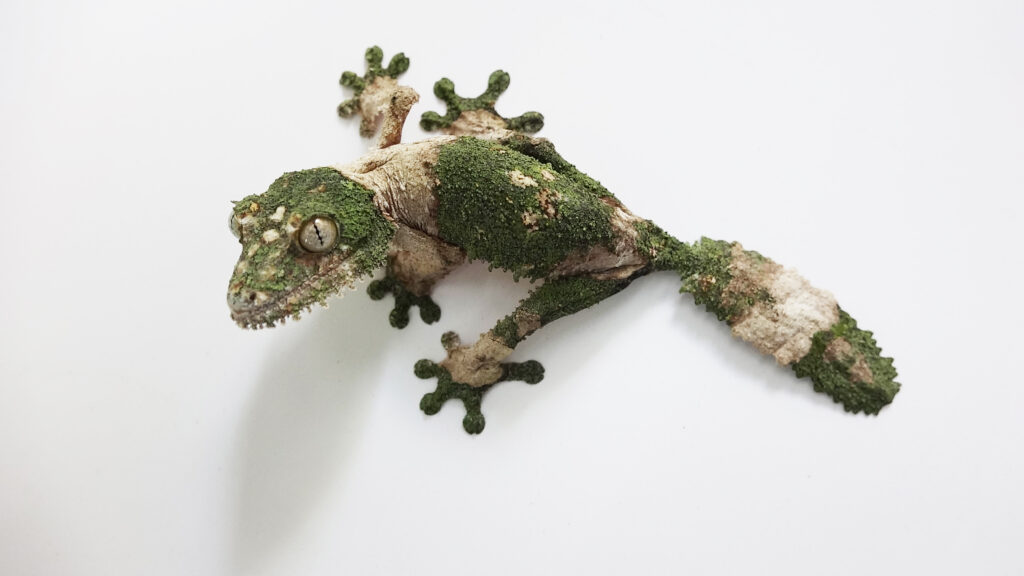
BION Terrarium Center has many years of experience in keeping mossy leaf-tailed gecko (Uroplatus sikorae, Boettger, 1913).
Mossy leaf-tailed gecko (Uroplatus sikorae, Boettger, 1913) is a medium-sized leaf-tailed gecko.
Adults may attain an SVL of 85 – 123 mm (3.35 – 4.84 in), TL of 65 – 77 mm (2.56 – 3.03 in) (total length 150 – 200 mm (5.90 – 7.87 in). Total length for juveniles is about 60–70 mm (2.36-2.75 in).
The body is strongly flattened. Relatively large head is also flattened and terminates in a rounded snout. Less than 35 supralabial scales are present.
Coloration is extremely variable: moss green, lichen and bark color, rarely reddish and a black buccal membrane (https://www.reptifiles.com/uroplatus-leaf-tailed-gecko-care/uroplatus-leaf-tailed-gecko-species/).
The ventral part of the body and limbs are white to reddish with numerous fine black spots. The iris is yellowish. A marked dermal fringe runs along the whole body. Males are easy to sex thanks to their hemipenal bulges (Svatek, van Duin, 2001; Gehring, 2020). These arboreal geckos have the ability to change their skin color to match their surroundings and possess dermal flaps which break up their outline when at rest (Ratsoavina at al., 2013). A dermal flap lines the body and legs enabling to hide their outline when fully utilized.
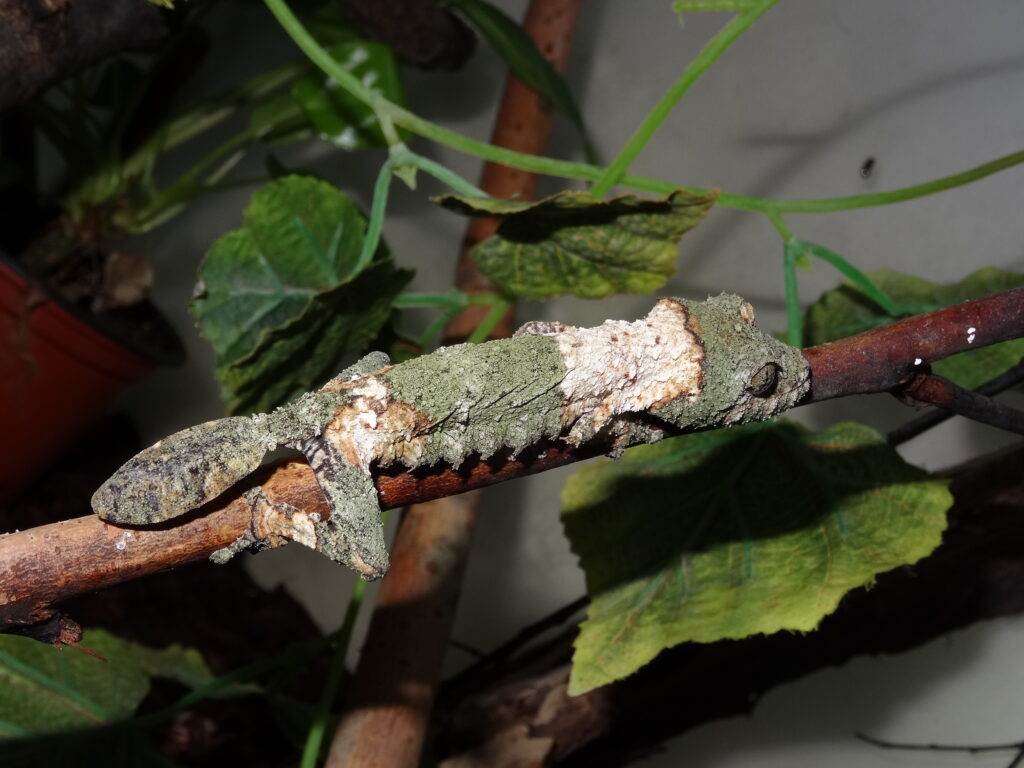
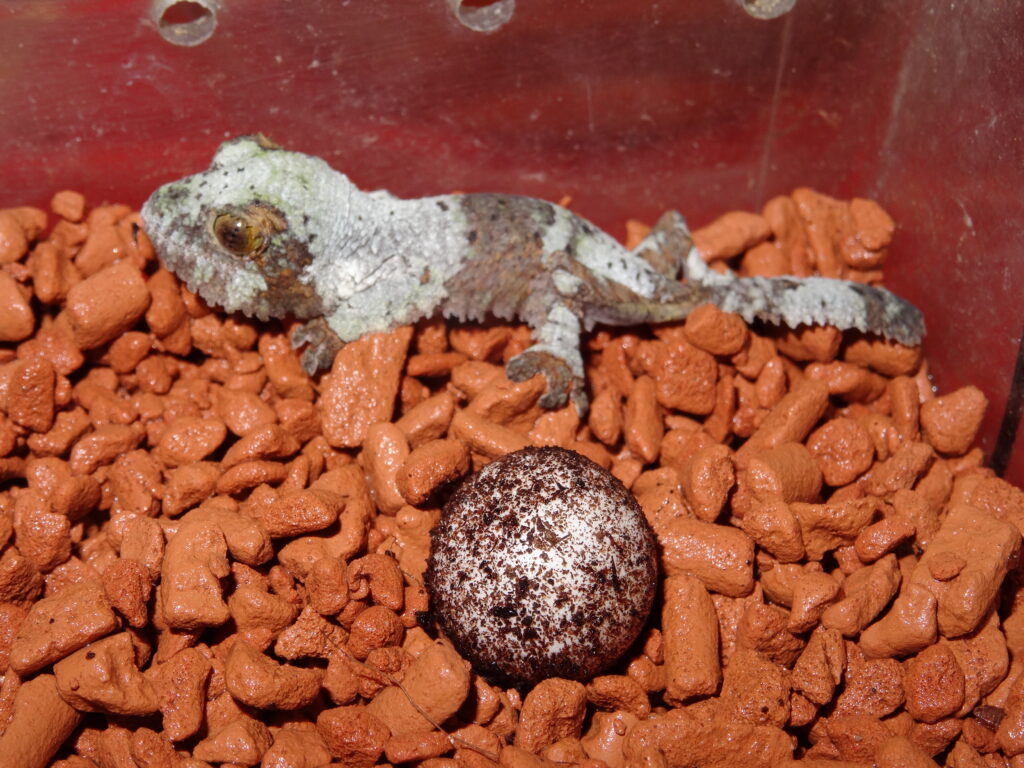
Keeping. We keep adult males and females separately or in pairs, at 70*50*50 cm (27.5*19.7*19.7 in) terrariums; babies are kept only separately at terrariums of not less than 30*30*45 сm (11.8*11.8*17.7 in). The decoration of the terrarium includes horizontal and vertical branches of medium thickness, lianas, layers of bark for climbing, hollows, living plants and shards as shelters. Substrate—crushed small pieces of bark with layer of dry oak leaves.
Paper with a box of wet coconut substrate as moist chamber is also an option. Water dish is obligatory
Lighting. Zoo Med 5 UVB lamp is used during breeding season for 10–14 hours per day; during period of winter dormancy (2 months) for 4 hours per day. Temperature. Daytime temperature is +24 – +26 °C (75.2-78.8 F), at night: +19 – +21 °C (66.2-69.8 F); at the time of winter dormancy: +18 – +21 °C (64.4-69.8 F).
Heating with 25W incandescent lamp is used only during wintering months to maintain daytime temperature. During breeding season we use no heating source. UVB is important for successful breeding.
Diet. Diet for adults contains Turkestan cockroaches (Shelfordella tartara), and crickets (Jamaican field crickets (Gryllus assimilis) and Mediterranean field cricket (Gryllus bimaculatus).
Locusts and soft-shelled snails are used as additional food and treats, which are given 1-2 times per month. We offer 2–3 insects per head 1–2 times per week. If the animal shows signs of obesity, the frequency of feeding is reduced to 1 time per 2 weeks.