Keeping and Breeding of Southern Leaf-Tailed Gecko (Uroplatus sameiti (Bohme & Ibish, 1990)) at BION Terrarium Center

BION Terrarium Center has many years of experience in keeping southern leaf-tailed gecko (Uroplatus sameiti (Bohme & Ibish, 1990))
Uroplatus sameiti (Bohme & Ibish, 1990) or southern flat-tailed gecko was separated from another species, U. sikorae, and is one of medium-sized species of the genus.
Adults may attain SVL of 110–130 mm (4.33-5.11 in) and TL of 50 mm (1.96 in) (total length 150–160 mm (5.91-6.29 in). Total length of juveniles is 70–80 mm (2.75-3.14 in). The body is dorsoventrally flattened. The flattened head terminates in a rounded snout. Their eyes are large, lidless, and have yellow sclera with elliptical pupils, suited for the gecko’s nocturnal habits. The tail bears an evenly undulating or weakly serrated fringe. Mostly, these animals show lichen patterns in coloring. Until 2006, U. sameiti was considered to be U. sikorae.
The distinction between the two species is now well known. For more info follow the link .
The best way to distinguish U. sameiti from U. sikorae is to check the buccal mucous membrane (located at the back of the mouth/throat). U. sameiti will have a uniformly pink or flesh colored buccal membrane while that of U. sikorae will be black (http://uroplatus.info/archives/59). Males have well-seen hemipenal bulges, while females don’t (Svatek, van Duin, 2001; Gehring, 2020).
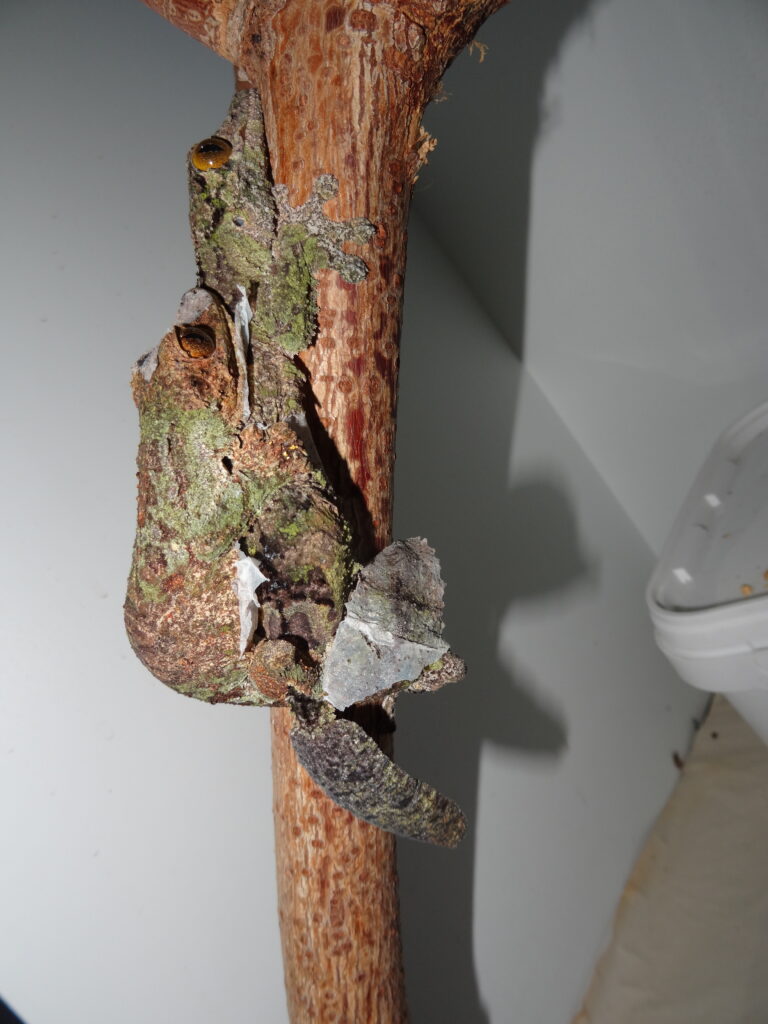
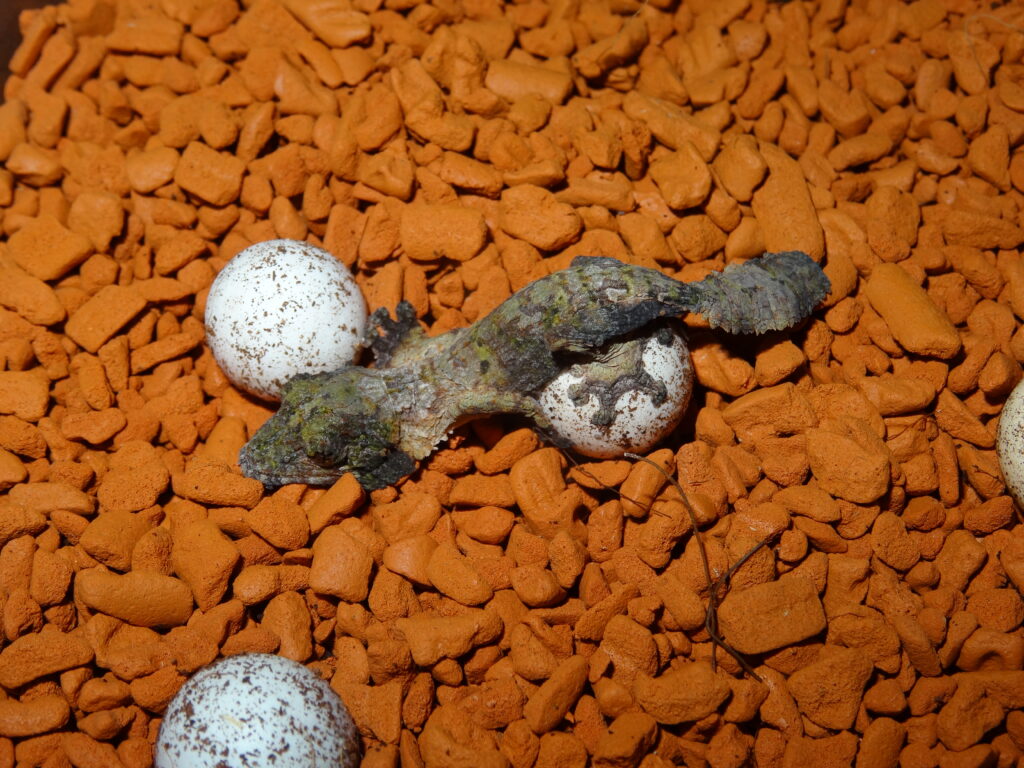
Keeping. We keep this species at terrariums of 45*45*60 cm (17,1*17,1*23,6 in) for adults, and at terrariums of not less than 30*30*30 сm (11,8*11,8*11,8 in) for babies. The decoration of the terrarium includes horizontal and vertical branches of medium thickness, lianas, layers of bark for climbing, hollows, living plants and shards as shelters. Substrate — crushed bark, covered with dry oak leaves. Paper towel with a box of wet coconut substrate as moist chamber is also an option. Water dish is obligatory.
Lighting. Zoo Med 5 UVB lamp is used during breeding season for 10–14 hours per day; during resting period (2 months) for 4 hours per day.
Temperature. Daytime temperature is +24 – +26 °C (75.2–78.8 F), at night: +19 – +21 °C (66.2-69.8 F); at the time of winter dormancy: +18 – +21 °C (64.4-69.8 F).
Heating with 25W incandescent lamp is used only during wintering months to maintain daytime temperature. During breeding season we use no heating source. UVB is important for successful breeding.
Humidity. Humidity is 75-90% both for babies and adults with double spraying during the day.
Diet. Diet for adults contains Turkestan cockroaches (Shelfordella tartara), and crickets (Jamaican field crickets (Gryllus assimilis) and Mediterranean field cricket (Gryllus bimaculatus).
Locusts and soft-shelled snails are used as additional food and treats, which are given 1-2 times per month. We offer 2–3 insects per head 1–2 times per week. If the animal shows signs of obesity, the frequency of feeding is reduced to 1 time per 2 weeks.
It is strictly recommended not to use wild caught insects. Sometimes if an animal is still hungry we can offer one or two additional feeding items. We offer soft-shelled snails for females during ovogenesis.
All insects should be gut loaded and dusted with vitamin-mineral supplementation every other feeding. Sepia or cuttlefish “bone” powder works well as a source of calcium. Insects are dusted with it prior to the feeding session.